English


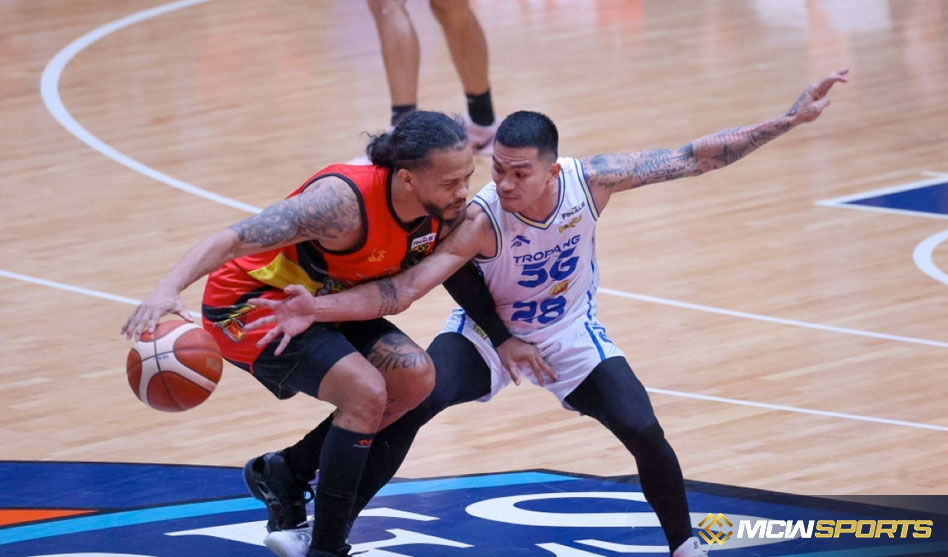
MANILA, Philippines – Chris Ross delivered a historic performance in a defining PBA Philippine Cup semifinal game, pouring in 40 points while anchoring a smothering defensive effort that smothered TNT Tropang 5G sharpshooter Mikey Oftana. In a game that had major ramifications for the series, Ross reminded everyone that offense gets the headlines, but defense, especially when played at elite levels, wins championships. His 40-point outburst mixed with lockdown defensive tenacity showed why he is one of the most influential two-way players in the game.
From tip-off, Ross played with the zeal of a seasoned competitor who realizes that every possession in the postseason has tremendous importance. Whether driving into the paint, attacking closeouts, or hitting clutch jumpers, his scoring prowess was evident throughout the encounter. Yet what truly characterized his performance was how perfectly his offensive intensity complemented his persistent defensive focus.
TNT’s Oftana began the series as one of the most consistent threats from beyond the arc, his rhythm and catch-and-shoot effectiveness forcing opposing defenses to modify coverage tactics and rotations. Containing a scorer of his quality is no small chore — especially in a series with so much on the line. But Ross’s approach was never passive. He pressed, pressured, and pursued positions that limited Oftana’s clear looks, forcing tougher shots and disturbing timing throughout the night.
Ross’s defensive mastery was enhanced by his ability to match it with effective scoring. Typically, heavy defensive participation can sap attacking energy, especially over extended minutes in hard playoff games. Instead, Ross sustained intensity on both ends, scoring in waves that kept the Beermen ahead while maintaining a defensive presence that made it impossible for TNT to find a solid offensive footing.
Throughout the game, Ross’s play generated momentum shifts – not simply by scoring, but with stops that galvanized his teammates and the audience. Defensive possessions often led to transition opportunities, where his decision-making, whether it was a quick entry pass or a pull-up jumper, put San Miguel in charge. It seemed as though every play held a dual objective: produce a scoring chance while simultaneously disturbing the opponent’s rhythm.
Veteran poise is part of what characterizes a player at Ross’s level, and he displayed it in spades. In high-pressure moments, possessions where a loose ball, contested shot, or simple rebound could alter the game’s narrative, Ross remained poised. On defense, he used screens to communicate, made calculated shots, and used his postseason expertise when strategy and physicality clashed. This blend of instinct and understanding was obvious in key situations where the Beermen needed both buckets and stops to maintain their advantage.
San Miguel’s coaching staff praised Ross’s performance not just for the numbers, but for its influence on team dynamics. Defense, as they echoed, is not only an individual pursuit; it is a community philosophy. The entire squad was inspired to match Ross’s enthusiasm and attention by his outspoken leadership and unwavering energy. Defensive reads resulted in scoring opportunities during crucial transitional times, demonstrating how disciplined defense can inspire offense.
On the offensive end, this was one of Ross’s most efficient scoring displays of the season. However, because his 40 points came in an environment where critical timing and shot selection were more important than raw volume, their worth was increased. He penalized mismatches, exploited coverage flaws, and showed a knowledge of spacing that created paths for cutters and shooters who profited from the attention he demanded in addition to himself.
Conversely, Oftana’s night was defined by the effort of managing Ross’s defensive pressure. His normal rapid release and catch-and-shoot routine was broken repeatedly by physical closeouts, aggressive hand pressure, and clever denial on catch locations. As Ross pressed the pace defensively, Oftana saw fewer clear looks and more contested opportunities, exactly the type of disruption that can tilt a tightly contested series.
Ross’s 40 points at the end of the game were an outstanding statistic in and of themselves. But what struck viewers was the context: this scoring explosion was accompanied by an excellent defensive effort against one of the league’s finest perimeter threats. It was a dual-threat effort that emphasized a fundamental truism of playoff basketball: offense may win games, but defense wins championships.