English


Gilas Pilipinas will head into the next FIBA World Cup Asian Qualifiers window with a different look after losing both of its naturalized-player options, forcing the national team to rely entirely on its Filipino pool.
Justin Brownlee will not be available for the upcoming games, while Bennie Boatwright’s naturalization process has not yet reached the point where he can suit up for the Philippines. As a result, Gilas will enter the window without the naturalized reinforcement that has become a familiar part of its recent campaigns.
It is an unusual situation for a national team that has increasingly relied on its naturalized players to provide additional size, scoring and versatility against some of Asia’s strongest opponents.
Brownlee, in particular, has become a major part of Gilas Pilipinas’ recent success.
Since gaining eligibility to play for the Philippines, the veteran forward has provided the national team with a reliable scoring option while also contributing on the boards and defending multiple positions. His ability to play both inside and outside has made him particularly valuable in international competition.
His absence will therefore force Gilas to make significant adjustments.
Brownlee is unavailable because of his current physical condition, preventing him from joining the team for this qualifying window. Rather than risk his health by rushing him back, the national team will move forward with the players who are available.
Boatwright could have provided another option, but his naturalization has yet to be completed.
Although the process has progressed, he still does not have everything required to represent the Philippines in an official international game. That leaves Gilas without a naturalized player for the upcoming assignment.
The situation places greater responsibility on the country’s local stars.
Fortunately for head coach Tim Cone, the Philippines still has a deep group of experienced players capable of handling increased roles.
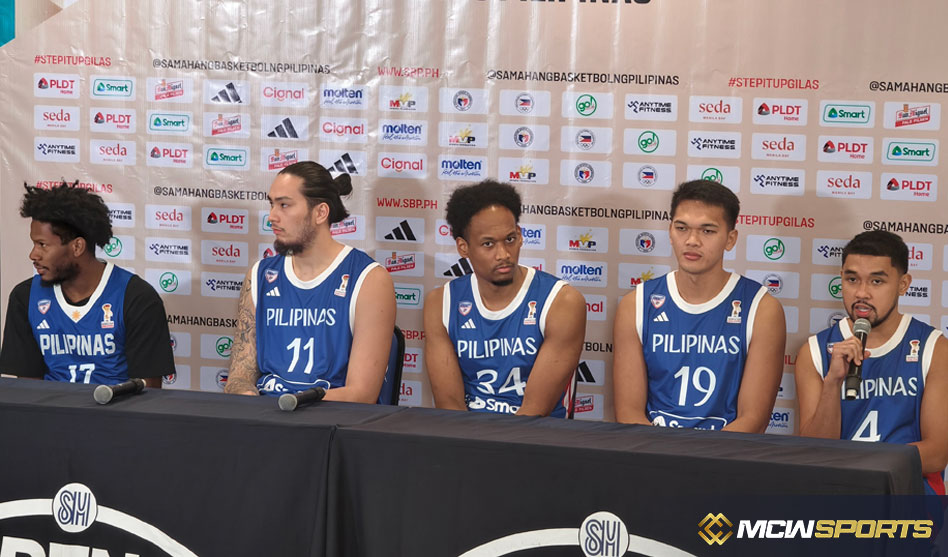
Kai Sotto, June Mar Fajardo and AJ Edu are among the players expected to carry significant responsibility in the frontcourt. Their size and international experience could help Gilas compete physically despite the absence of its usual naturalized presence.
Sotto, in particular, could be asked to shoulder more responsibility.
His ability to operate around the basket while also contributing defensively gives Gilas an important option in the middle. Fajardo brings years of experience and physicality, while Edu offers athleticism and defensive versatility.
Together, they could help fill some of the void created by Brownlee’s absence.
The challenge, however, will not be limited to the frontcourt.
Brownlee’s departure from the lineup also removes a player capable of creating his own offense when the team needs a basket. Without him, Gilas will likely need greater contributions from its guards and wings.
Instead of relying on one player to generate points, the Philippines may have to distribute the offensive workload across the lineup.
That could make ball movement particularly important.
The team’s guards will need to create opportunities for their teammates, while the shooters must make the most of their chances from outside. At the same time, Gilas’ big men will have to convert their opportunities near the basket and provide second-chance points whenever possible.
Defensively, the Philippines will need to remain organized.
Playing without a naturalized player means the team cannot afford breakdowns that give opponents easy scoring opportunities. Strong communication, rebounding and disciplined rotations will become even more important as Gilas faces physically demanding opposition.
The upcoming window will test that approach immediately.
Gilas is scheduled to face Jordan and Iran, giving the Philippines two difficult assignments. Both teams have considerable international experience and will provide a stern examination of the all-Filipino lineup.
The games also come at an important point in the qualification campaign.
With the World Cup race continuing, every result matters. Gilas cannot afford to allow the absence of Brownlee or the unfinished naturalization of Boatwright to derail its campaign.
Instead, the national team must adapt quickly.
For Cone, this could mean changing the way Gilas distributes its offensive responsibilities and uses its frontcourt. The coaching staff will need to maximize the strengths of the available players while ensuring that the team does not become predictable.
The situation could also create opportunities for players who have previously occupied smaller roles.
With Brownlee unavailable, some members of the squad may be asked to take more shots, defend tougher assignments or spend additional time handling the ball. That increased responsibility could be valuable for the development of the national team beyond the current qualifying window.
It may also reveal how well Gilas can function as a collective unit.
The Philippines has spent years building a national team capable of competing at the international level. Having no naturalized player available presents a significant challenge, but it also gives the local core an opportunity to demonstrate that it can carry the team when circumstances demand it.
There is no guarantee that the adjustment will be seamless
Brownlee’s absence removes a proven international performer, while Boatwright’s delayed naturalization means another potential reinforcement remains unavailable. Gilas will therefore have to find production and stability from within its existing roster.
That task becomes even more difficult against teams such as Jordan and Iran.
Still, the circumstances leave the Philippines with little choice but to move forward.
The focus now shifts to preparation, execution and collective effort. Every player will have a role to play, and Gilas will need contributions from across the lineup if it hopes to come away with important results.
The upcoming window could ultimately become a valuable test for the national team’s local talent.
For now, though, the objective remains unchanged.
Gilas Pilipinas wants to keep its World Cup qualifying campaign on track, and it will attempt to do so without a naturalized player on the roster.
Brownlee will have to watch from the sidelines, while Boatwright waits for his naturalization process to be completed.
The responsibility now belongs to the Filipino players.
Against Jordan and Iran, Gilas will have to prove that the absence of its naturalized reinforcement does not have to mean the absence of competitiveness.
The challenge is significant, but it also presents a chance for the Philippines’ local stars to step forward when their national team needs them most.